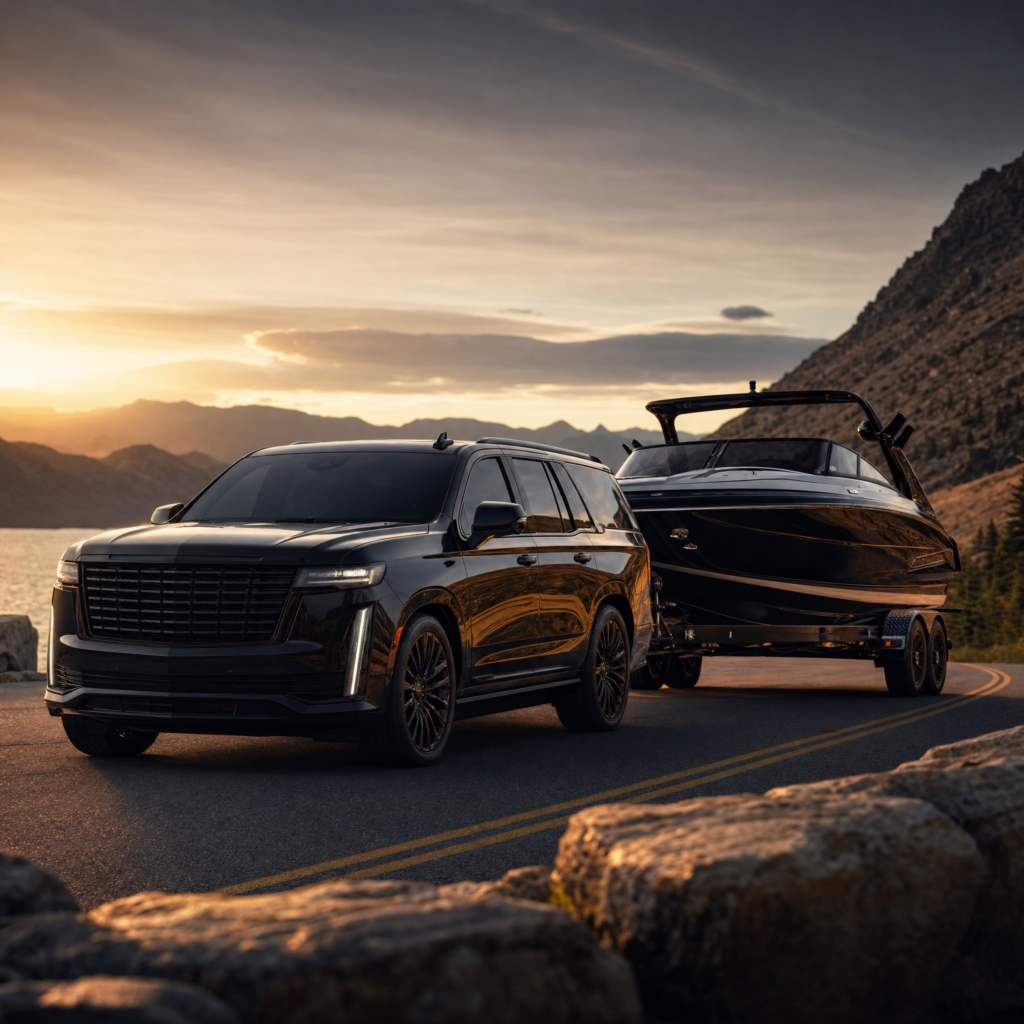
Most people who call me about towing with an Escalade do not ask “what is the max rating.” They ask “can it actually pull my camper.”
Fair question. Better question, honestly. The number on the window sticker and the number that matters when you are heading west on I-90 with a travel trailer behind you are two different things.
I sell Cadillacs at Luxury Auto Mall in Sioux Falls. I hook trailers to these trucks, I load them, and I hand the keys to people who tow every weekend all summer. So here is the straight version of 2026 Cadillac Escalade towing capacity, what those numbers really mean, and where people get burned.
The Short Answer on 2026 Escalade Towing Capacity
Here is the whole lineup, properly equipped:
| Model / Configuration | Towing Capacity |
|---|---|
| 2026 Escalade, standard wheelbase, rear-wheel drive | around 8,100 lbs |
| 2026 Escalade, standard wheelbase, four-wheel drive | roughly 7,800 to 8,000 lbs depending on how it is built |
| 2026 Escalade ESV, rear-wheel drive | around 8,000 lbs |
| 2026 Escalade ESV, four-wheel drive | roughly 7,700 to 7,800 lbs |
| 2026 Escalade-V | around 7,200 lbs |
| 2026 Escalade-V, ESV form | about 7,000 lbs |
| 2026 Escalade IQ (electric) | around 8,000 lbs |
| 2026 Escalade IQL (electric, longer wheelbase) | closer to 7,500 lbs |
Every gas Escalade this year runs the same 6.2L V8. 420 horsepower, 460 lb-ft of torque, ten-speed automatic. That is the engine doing the pulling in the 1SA, Luxury, Sport, Platinum Luxury and Platinum Sport. The Escalade-V gets a supercharged version of that same V8.
One thing I want to flag, because published numbers move around by a couple hundred pounds depending on axle ratio, wheel package and options. If you are buying to tow a specific trailer, do not trust a round number off a blog. Text me the trailer and I will pull the exact rating off the door jamb and the build sheet of the actual unit you are looking at. That takes me two minutes.
Why Four-Wheel Drive Tows a Little Less
This surprises people every time. You would think four-wheel drive means more capability, so it should tow more.
It does not work that way. Four-wheel drive adds a transfer case, a front driveshaft and a front differential. That is a few hundred pounds of curb weight, and tow ratings come off a fixed gross combined weight limit. Every pound the truck gains is a pound the trailer loses.
You are giving up two to four hundred pounds of trailer for traction. In South Dakota, with a boat ramp in April or a gravel approach after a rain, that trade is usually worth it. But know you are making it.
What 8,100 Pounds Actually Pulls
Numbers are abstract. Trailers are not. Here is the translation.
Boats
A 21 to 24 foot bowrider or pontoon, trailer included, generally lands between 4,000 and 6,500 lbs wet. An Escalade handles that without breathing hard. That covers most of what I see going to Lake Madison, Okoboji and Lewis and Clark.
Where it gets tight is a big wake boat with ballast tanks full. Those can push 7,500 lbs before you load a single cooler. Doable, but you are near the ceiling.
Travel Trailers and Campers
This is the one people get wrong. A travel trailer’s advertised “dry weight” is a fantasy number. It is the trailer before water, propane, batteries, a generator, food, chairs, bikes and everything else you actually bring.
Add 1,000 to 1,500 lbs to any dry weight you read in a brochure. That is your real towing weight. So a camper listed at 6,000 lbs dry is realistically a 7,000 to 7,500 lb tow. Fine behind an Escalade. A camper listed at 7,500 lbs dry is not fine, even though 7,500 looks like it fits under 8,100.
Fifth wheels are a hard no. The Escalade is a body-on-frame SUV with a conventional receiver hitch, not a truck bed. If you are shopping fifth wheels you need a pickup.
Horse Trailers
A two-horse bumper pull with a dressing room runs roughly 3,500 to 5,000 lbs empty. Add two horses at 1,000 to 1,300 lbs each and you are in the 6,000 to 7,500 lb range. That works.
Three horses and a living quarters trailer does not. That is truck territory, and I will tell you that rather than sell you an Escalade that will be miserable doing it.
The Number Nobody Talks About: Payload and Tongue Weight
This is the part that actually strands people, and almost no towing article covers it.
Your Escalade has a max payload of roughly 2,000 lbs. Payload is everything you put in or on the vehicle. People, luggage, the dog, the cooler… and the tongue weight of the trailer pressing down on the hitch.
Tongue weight is usually 10 to 15 percent of your loaded trailer weight. So an 8,000 lb camper puts 800 to 1,200 lbs straight onto your hitch.
Now do the math. 1,000 lbs of tongue weight, plus a family of five at roughly 700 lbs, plus 300 lbs of gear in the back. You are at 2,000 lbs of payload while still technically “under” the tow rating.
That is how people end up legal on paper and squatting in the driveway. A weight distributing hitch fixes the squat and the steering feel, and I would recommend one on anything over about 5,000 lbs. It does not raise your payload ceiling though. Nothing does.
There Is No Diesel Escalade Anymore
Worth saying plainly because there is a lot of stale information floating around. The 3.0L Duramax inline-six was dropped from the Escalade after the 2025 model year.
For 2026 your gas choices are the 6.2L V8 or the supercharged 6.2L in the V-Series. That is it. If a listing or an article is telling you to spec the diesel for better towing, it is out of date.
For towing you are not missing much. The diesel had great unloaded mileage, but its tow ratings were in the same neighborhood as the V8, and the V8 pulls a grade harder.
Escalade vs ESV vs V vs IQ for Towing
Quick decision guide.
Standard wheelbase Escalade tows the most on paper and is easier to back into a campsite. If towing is the priority and you do not need the extra cargo room, this is the pick. More on the whole lineup in my 2026 Cadillac Escalade rundown.
Escalade ESV gives up around 100 lbs of tow rating and gains a large amount of cargo space behind the third row. If you are hauling a family plus gear plus a trailer, the ESV usually wins in real life even though it loses on the spec sheet. I broke that down further in the 2026 Escalade ESV writeup.
Escalade-V is the least practical tow vehicle of the group at around 7,200 lbs. It is a 682 horsepower performance SUV. It will absolutely yank a trailer, but you are paying a lot for capability you give up.
Escalade IQ tows around 8,000 lbs, which is genuinely impressive for an electric SUV. The honest caveat is range. Towing near capacity can cut an EV’s range roughly in half. For hauling a boat 30 miles to the lake and back, great. For pulling a camper to the Black Hills, plan your charging carefully or take the gas one.
Trailering Tech That Actually Helps
The Escalade comes with a factory hitch platform and a seven-pin connector, so you are not adding aftermarket wiring.
The features I actually point out to customers:
- Tow/Haul mode. Changes shift points and adds engine braking on descents. Use it. Every time.
- Hitch Guidance with Hitch View. Puts a guideline on the rear camera and zooms in on the ball. Hooking up solo goes from a two person job to a thirty second job.
- Trailer light and brake integration. Most builds have an integrated trailer brake controller, but I would verify it on the specific unit rather than assume.
You can cross-check standard equipment on the official Cadillac Escalade page, then ask me what is actually on the one sitting in our lot. Those are not always the same thing.
What a 2026 Escalade Costs
Broad strokes, a 2026 Escalade lands somewhere in the low $90,000s at the entry end and climbs well past $160,000 for a loaded Escalade-V. ESV models generally carry a few thousand over the standard wheelbase.
I am not going to throw a hard MSRP at you, because MSRP is not what you pay and it is not what you finance. Freight, options, rebates, your trade and your credit all move the real number.
I would rather give you the actual out-the-door figure on a specific stock number than have you chase a generic price you saw on a search result. Ask me and I will send it over. No pressure attached to it.
FAQ
Can a Cadillac Escalade tow a camper?
Yes. A 2026 Escalade tows around 8,100 lbs properly equipped, which covers most single axle and many dual axle travel trailers. Just budget 1,000 to 1,500 lbs above the brochure dry weight for real world loaded weight, and watch your tongue weight against payload.
What is the 2026 Cadillac Escalade ESV towing capacity?
Around 8,000 lbs in rear-wheel drive and roughly 7,700 to 7,800 lbs with four-wheel drive. Slightly less than the standard wheelbase because the ESV weighs more.
Does the Escalade still offer a diesel engine?
No. The 3.0L Duramax diesel was discontinued for the Escalade after 2025. Every 2026 gas Escalade uses the 6.2L V8, and the V-Series uses a supercharged version of it.
How much can the Escalade-V tow?
Around 7,200 lbs for the standard wheelbase Escalade-V and about 7,000 lbs for the V in ESV form. Less than a regular Escalade, because the V weighs more and is tuned for performance rather than trailering.
What is the Escalade IQ towing capacity?
Around 8,000 lbs for the Escalade IQ and closer to 7,500 lbs for the longer IQL. Strong for an electric SUV, but expect a significant range hit when you are towing near the limit.
Do I need a weight distribution hitch with an Escalade?
Not required by rule, but I recommend one on anything over roughly 5,000 lbs. It levels the vehicle, restores steering feel and makes crosswinds on the interstate far less exciting.
Come Hook One Up
If you are trying to figure out whether your specific boat, camper or horse trailer works behind a specific Escalade, that is a five minute conversation and I am happy to have it. Bring the trailer if you want. I will give you a straight answer, including telling you to buy a truck instead if that is the real answer.
No pressure, no games, and the best price I can put together. Reach out and come see the Escalade at Luxury Auto Mall in Sioux Falls.